4
min read

A meeting assistant can produce an excellent summary and still leave an advice business with a poor client record. That is the uncomfortable part of the current AI rush. The visible output may improve while the underlying workflow remains fragmented: one version of a fact-find in the CRM, another in a report, platform data somewhere else, and an adviser still deciding which record is current.
For self-employed advisers, that is the real buying decision. The first question is not, “What can this AI tool write?” It is, “What happens to the client record after it writes it?”
The market is moving from features to flow
Three announcements in the evidence window point in the same direction. A major company on the UK's advice market described a unified workspace that captures meetings, updates the client record and connects it to suitability reporting and back-office systems. Some others announced automated valuation data flowing into existing adviser workflows. There's even those who are focused on applying a central investment proposition across client books using a single view of platform, product and investment data.
These are company announcements, so their performance claims should be read as directional, not independent proof. But the shared design problem is hard to miss. Adviser technology is being asked to move information across the whole advice journey, not merely make one task quicker.
The regulator's evidence adds weight to that interpretation. In its 2026 wealth-management survey, the FCA said firms need clear governance, effective client support and responsible use of technology, including AI. It also identified AI uses in decision support, records management and control processes. The FCA's broader financial-advice market survey describes uneven technology adoption and a market in which ongoing service, assurance and management information remain material issues.
The commercial implication is simple: a clever assistant attached to a weak operating model can accelerate the weak points as easily as it improves the strong ones.
Fintuity relevance: Self-employed advisers should not have to assemble licence, compliance, technology and operating support one disconnected component at a time. Explore Fintuity's supported self-employed adviser model and arrange a conversation with the Head of Growth about the infrastructure behind your next stage of growth.
Start by naming the authoritative client record
Every firm needs to know which system holds the record it would rely on when a question arises later. That does not mean every document must live in one application. It means there is an unambiguous source of truth and a controlled route for information to reach it.
A useful workflow map begins with the client conversation and follows the information through fact-finding, objectives, risk and capacity for loss, research, recommendation, suitability, implementation, ongoing service and management information. At each hand-off, ask four plain questions:
What data moves, and which fields are re-keyed?
Who reviews or approves the information before it becomes part of the client record?
How are corrections, conflicts and missing data handled?
Can the firm later show what happened, when it happened and who was responsible?
That exercise often exposes a more valuable automation opportunity than the first feature on a vendor demonstration. Removing a duplicate entry point or closing a break between systems may improve capacity and record quality at the same time.
Five tests before adding another AI tool
1. Record integrity
Can the tool read the right information and write its output to the right place? Check field-level permissions, version history and how corrections propagate. A generated report is not enough if the underlying objectives, assumptions or vulnerability information remain inconsistent elsewhere.
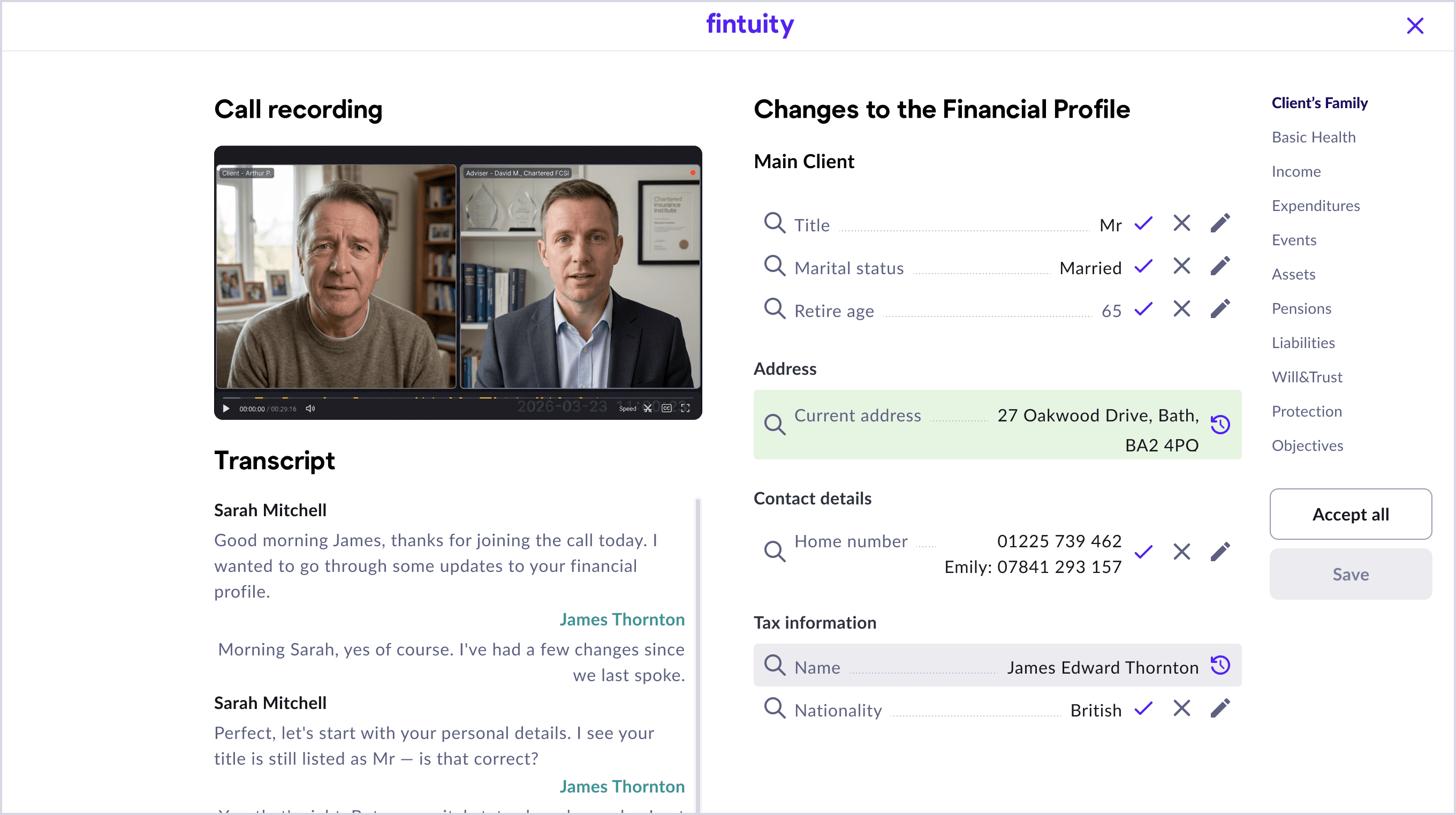
The Fintuity Platform is at the forefront of adviser technology, adding only practical, high-value tools that genuinely accelerate advisers’ workflows. Client calls can be automatically transcribed, allowing advisers to add key information from each conversation directly to the client’s financial profile quickly and easily. This reduces manual note-taking while helping ensure that important details are captured. The fact-find also provides a complete version history and changelog, showing what was changed, when and by whom.
2. Human accountability
Define where judgement sits. An adviser or authorised reviewer should know which output requires approval, what evidence they are approving and how the system records that decision. “Human in the loop” is too vague unless the loop has an owner and a stopping point.
3. Service evidence
Connected systems should prove delivery as well as store documents. Current Financial Ombudsman Service guidance says ongoing-advice complaints may turn on whether a paid-for service was received, whether reviews were invited or declined, the suitability of advice, communications and support for vulnerability. The practical record therefore needs service dates, invitations, outcomes, exceptions and remediation, not just meeting notes.
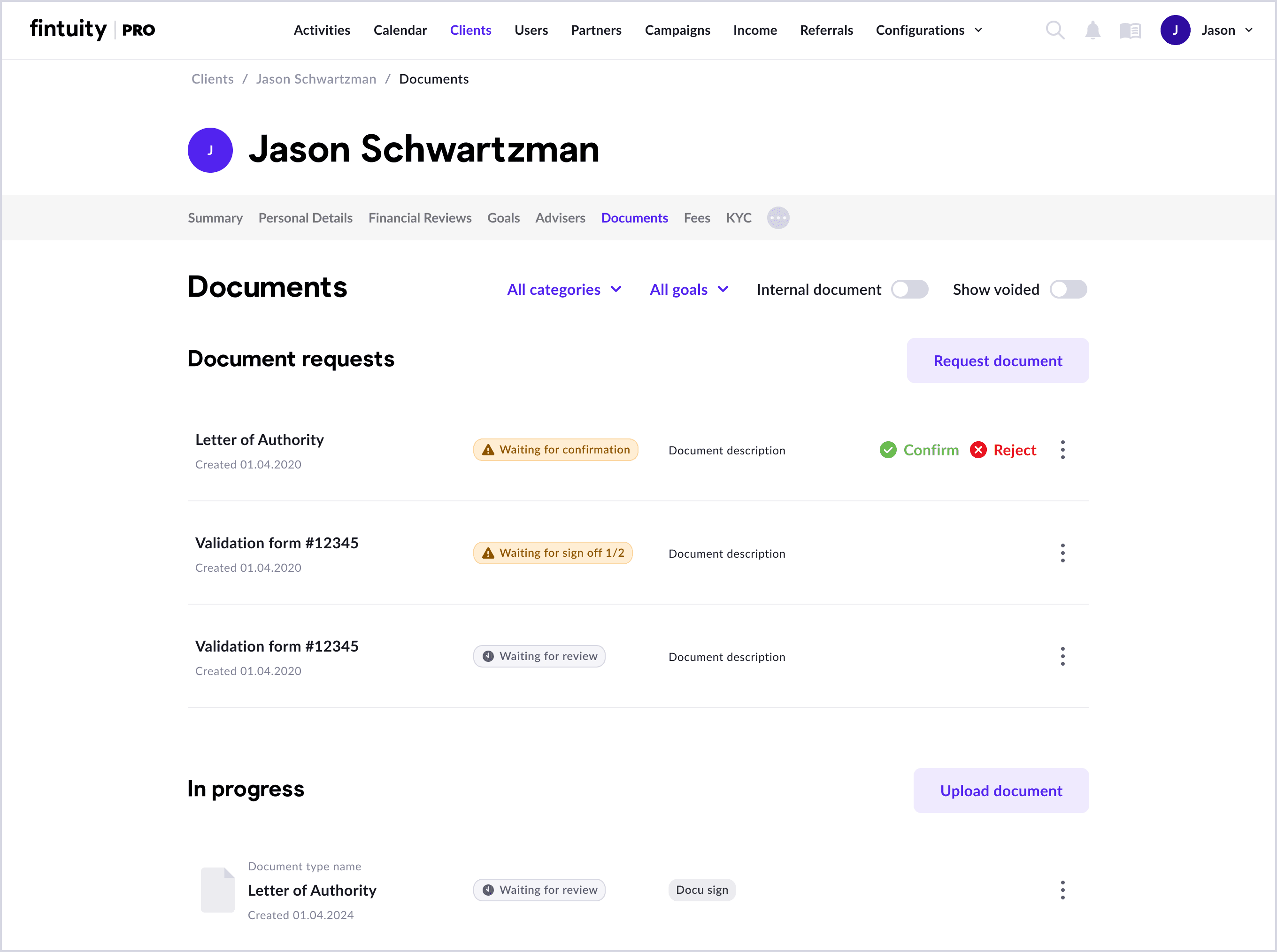
The Fintuity Platform brings this supporting information together in one clear, centralised location. Client documents are securely stored with easy-to-understand statuses, required actions and a transparent record of progress. Deep DocuSign integration also enables a fast, paperless process for advisers and clients who prefer to complete and sign documents digitally, while retaining flexibility for those who do not.
4. Integration and resilience
Ask what happens when an integration fails, a supplier is unavailable or access is compromised. Can the adviser continue serving clients? Can data be reconciled afterwards? Is there a tested recovery route? Fresh industry commentary on AI-enabled cyber threats is vendor-authored, but its operational advice is proportionate: understand critical systems, strengthen access controls, review supplier risk and plan for recovery.
5. Measured operational effect
Choose a small number of measures before the pilot starts. Useful measures might include re-keying removed, turnaround time, correction rate, exceptions, review completion and adviser time returned to client work. Do not treat a vendor's average saving as your business case. Measure the workflow in your own operating model.
What this means for a self-employed adviser
Self-employment should increase professional autonomy without forcing an adviser to become the integrator, information-security lead and workflow designer for a collection of unrelated systems. The support model matters because it determines how much of the adviser's day is spent on advice, how consistently cases move, and how readily the business can evidence what it has done.
When comparing support propositions, ask to see the journey rather than the list of logos. A credible provider should be able to demonstrate how a client record moves from conversation to recommendation, how compliance review works, where manual intervention remains, what management information is available, and how an adviser gets help when the normal path breaks.
That is also a growth question. A workflow that works for 80 client relationships may fail at 150 if every new case creates another manual hand-off. Conversely, automation that is governed and connected can help a business add capacity without pretending that judgement has been automated away.
A practical first move
Before approving a new tool, draw the current data flow on one page. Mark each system, each re-keying point, each human approval and each place where ongoing-service evidence is created. Then select one bounded improvement, such as meeting preparation and structured notes, and set accuracy samples, exception logs, data controls and rollback criteria before the pilot begins.
The purpose is not to slow adoption. It is to make the first implementation useful enough to build on. A tool that improves one step but weakens the client record creates hidden work for the next step.
Infrastructure is part of the advice proposition
AI will keep changing. Specific product claims, interfaces and suppliers will date quickly. The durable advantage is an operating model that can adopt useful technology without losing control of the client record or the adviser's responsibility.
For Fintuity, that is where the proposition should be tested: whether licence, compliance, technology, infrastructure and growth support work together in the daily advice process. For the adviser, the decision is whether that support returns time to client work while making the evidence chain clearer.
Next step: Discuss building a self-employed advice business on Fintuity's supported infrastructure with the Head of Growth. The conversation can start with your present data flow, the manual work you want to remove and the controls that need to remain visible.
Grow your advice business
Run your own firm with Fintuity’s advanced support.

Andrew Lumley-Holmes
Head of Growth at Fintuity
Unsubscribe at any time.